
MASuccess Magazine
The Martial Arts Industry Association's MASuccess Magazine exists to help grow martial arts participation by helping school owners succeed.
In Martial Art Schools, We’ve Hit the Trifecta!

By MAIA Executive Director Frank Silverman
It’s the most wonderful time of the year — for martial arts schools, that is. We’ve hit the trifecta: the end of the hot days of summer, the start of back-to-school time and the edge of the holiday season. Any one of these three warrants an individual column, or even a full- fledged article, but I have only 700 words. Since that’s the case, I will attempt to wrap everything into one column. I want to cover the essential details of the question, How do we handle the transition from summer’s end through back-to-school and into the holidays?
First, regardless of how good or bad summer was, we need to focus on getting everyone who took a break, no matter how long or short, back to regular class attendance. We know it’s always less expensive to keep a client than to find a new one, so hop on the phone, send emails and post to Facebook. You need to do whatever it takes to get your students back on the mat.
Host welcome-back events. Offer...
5 Insights Into the Human-Relations Side of Retention

By Christopher Rappold
Finding out that a student is going to be leaving your school is never fun. If you care about making an impact on someone’s life and sincerely enjoy teaching, news of a departure can create some sleepless nights. While there is no magic answer to ensure this never happens, your time will always be well-spent ensuring that the highest percentage of your students remain dedicated to their training at your facility.
As I look back over 25 years of teaching, I do so with pride in what our team has produced. But, like you, I’ve been stung with the unexpected news of a student discontinuing his or her training more than once. Since we preach, “You can either get bitter or get better,” I offer the following preventative measures designed to keep such surprises to a minimum.
1. Know Your Students Beyond the Mat
It’s easy to forget that our students have lives outside the few hours they spend training with us each week. They have school classes, careers, familie...
RETENTION DONE RIGHT!
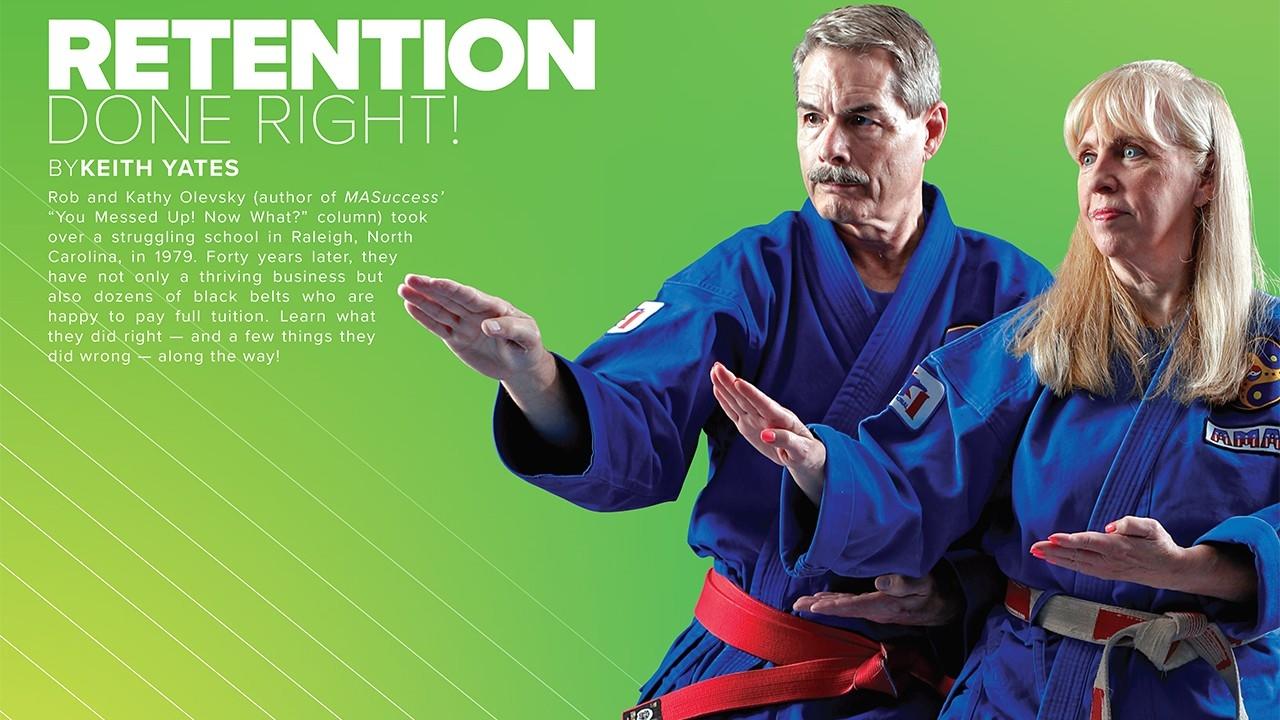
How Two Instructors Guide Their Students to Black Belt — and Then Retain Them as Contributing Members of the Dojo!
Rob and Kathy Olevsky (author of MASuccess’ “You Messed Up! Now What?” column) took over a struggling school in Raleigh, North Carolina, in 1979. Forty years later, they not only have a thriving business but dozens of black belts who are happy to pay full tuition. Learn what they did right — and a few things they did wrong — along the way!
By Keith Yates
It was the late 1970s, and Kathy Kilmartin was a 21-year-old taking karate lessons at the only martial arts school in Raleigh, North Carolina. She caught the eye of one of the instructors, a man named Rob Olevsky, but the dojo had a strict policy against teachers dating students. However, after repeated requests, the school’s owner says Rob could ask her out on a date — but only if Rob bought out Kathy’s contract in case she quit.
Rob agreed immediately, but Kathy wasn’t as eager when it came to dating. Rob ha...
How to Solve the Two-Inch Problem

By Christopher Rappold
What is it that separates a good competitor from a great competitor? I have asked that question many times, and I have heard many answers. To be great, someone must be fast. Or must be strong. Or must have a long reach. Or must have superior strategy. The list of answers goes on.
While all these are valid, I believe that the biggest deciding factor between good and great is whether a person can control distance.
This answer is what I would call “the elusive obvious.” It is self-evident, but sometimes we are so close to it that we don’t appreciate its value. If distance is controlled, then offense, defense, blocks, punches and kicks all work. If distance is off, they all are rendered useless.
If distance is such a critical element of success in martial arts, why is it that most schools place a premium on punching and kicking and only teach distance as a necessary evil? As I reflected on the answer and spoke with others, two answers emerged.
The first one i...
Motivate Your Masses: Part 2

Motivate Your Masses: Part 2
In my last column, Motivate Your Masses: Part 1, I went over some ways that you can inspire your “masses:” your students, their parents and your staff. However, much as you won’t have the energy to work out if you haven’t eaten, you won’t have the mental energy to motivate others if you’re not keeping up with your own welfare.
Part of being a great motivator is promoting a balanced lifestyle to those you care about. Home life, work commitments, online distractions and hobbies can pull you in a million directions. Internally, things can quickly become unbalanced, causing stress and unease.
Many will come to you for answers about how to create a successful, balanced life. Your words hold weight because of your position, so hand out wisdom with care. The answers you provide will be implemented, and those outcomes are a direct reflection of your ability to lead effectively. Realize that some will excel while others will falter within an...
My Student, Joe Hammel

By Dave Kovar
Every now and then, you meet someone who immediately grabs your attention. Joe Hammel was one of those people. I’ll never forget the day in the early 1990s when he walked into my school. He was 53 at the time, and I remember thinking how old he was. He told me that he had wanted to do martial arts since he was a teenager but never had the courage to get started.
I told him that it was never too late to start! Now was just as good a time as any! I didn’t really believe it, but I didn’t tell him that part.
Joe was no dummy. He was an English professor by day and a concert pianist by night. Smart he certainly was, but coordinated he certainly was not. During his first lesson, I remember thinking that he was the most ungraceful person I’d ever worked with. I asked him about prior athletic endeavors. He said he’d never done anything remotely like a sport in his whole life. It showed.
At first glance, the lack of previous physical training seemed like a big disadvantage....
5 Steps to Winning Workshops: Programming Product for Profit

Programming product for profit is when you pick a retail item and create a workshop to go around that item. Examples could include, but are not limited to, a square hand target, focus paddle, body shield, Wavemaster or even a stretch rack.
Hosting these workshops will not only increase retail sales and profitability, but will also increase retention. Students who spend money in your school today are less likely to quit tomorrow. Let’s dive in.
Step 1: Schedule a Day and Time for the Workshop
In this example, we will often host square hand target workshops, as this is a simple-to-use item that anyone can benefit with from at-home training. We like to do these workshops on a Saturday from 11:00-noon. You can pick any day and time that will work for your schedule.
Step 2: Set a Limited Number of Spaces
Limit the participants to a number you know will sell out, and when the event fills up do not let any additional participants register. Let them kno...
Allowing Revenue to Help Prioritize Your Time Management

By Christopher Rappold
There’s an old business adage that reads, “It costs seven times more to acquire a new customer than it does to sell to an existing customer.” And when it comes to operating a martial arts school, it has never been more true.
Think about it – what does it cost you in actual dollars to get a new student? Even if your school has great systems in place, and you only spend time, effort and energy doing low- or no-cost activities, you have to admit that it is still labor intensive.
Now, contrast that with taking steps to ensure that your students are making progress and moving towards their goals – something you should be doing anyway. When you compare actual time and money spent keeping students on track to their goals versus the efforts and money it takes to add a student, it may make you take a second look at how you prioritize your time.
Try some quick math. Review all the memberships you have in your school. How many students are on their first program and ...
Combat the Summertime Slump by Winning the Retention Battle

By MAIA Executive Director Frank Silverman
In a recent column, I discussed the need for focusing on enrollments during the summer month. Even though summer enrollments are often less than stellar, it's important that we work towards getting new students.
I suggested ways to capture the low-hanging fruit: siblings and parents. Assuming you’re focused on new-member enrollment, a focus equal in importance during the summer is retention. It does no good to open the front door to a new student only to lose one through the back door.
There are quite a few reasons that summer retention is difficult. First, you are competing with the swimming pool and the season’s extended daylight hours. As much fun as it is to train in martial arts, in the summer months, staying out late and playing with friends is big competition.
There’s no getting around heat and nice weather being an issue for many students. Just as important is the fact that families break their normal routines with out-of-town v...
5 Mistakes that are Killing your Sparring Program

By Christopher Rappold
When I walk into a school and see two or three high-level students training at the prime time (4:00 pm to 8:00 pm), with no other members in site, my eyebrows raise. When I see a class full of students who are not performing the technical skills correctly, I get restless. Each of these extremes are different, but, in both cases, the school owners or instructors are probably making one of the 5 Mistakes that can sabotage a sparring program. So what are the 5 Mistakes? Well let’s take a look at each one so you can make certain you aren’t making them.
Mistake Number 1 – Teaching offense first.
Sparring is learning how to move with another partner. To do it well, a student needs to be able to relax. They can only relax if they feel safe. Instructors have to remember to perceive safety though the eyes and feelings of a beginner. Help everyone feel safe by teaching defense first.
Mistake Number 2 – Developing speed and power while sparring.
The purp...

Want Some Help with Your School?
Connect with us! Discover how MAIA can help you on your journey today.
Stay connected with news and updates!

Categories
All CategoriesRecent Posts