
MASuccess Magazine
The Martial Arts Industry Association's MASuccess Magazine exists to help grow martial arts participation by helping school owners succeed.
Balance the New With the Old

by Kathy Olevsky
I’ve operated a martial arts school full time for 45 years. I may have made every mistake that can be made in this business. The reason I’m still in business, I believe, is I asked for help. I learned quickly that others before me had already found solutions. In this column, I’ll point out key mistakes I made in my career, which are common errors among school owners, both large and small, throughout our industry. And I’ll share the solutions I used to overcome them.
Over the years, I have realized the importance of balancing the addition of new things with the maintenance of tradition and integrity. In my school’s karate program, we adhere to the same high standards as we always have. The black belt of today is the same as the black belt of many years ago. However, many of our students also partake in our yoga-stretch class, our cardio-fitness class, and our judo and jujitsu classes.
In this industry, it’s essential to explore new ideas to stay ahead of the cu...
Premier Martial Arts: The Franchise That’s Leading the Pack in the Martial Arts Industry
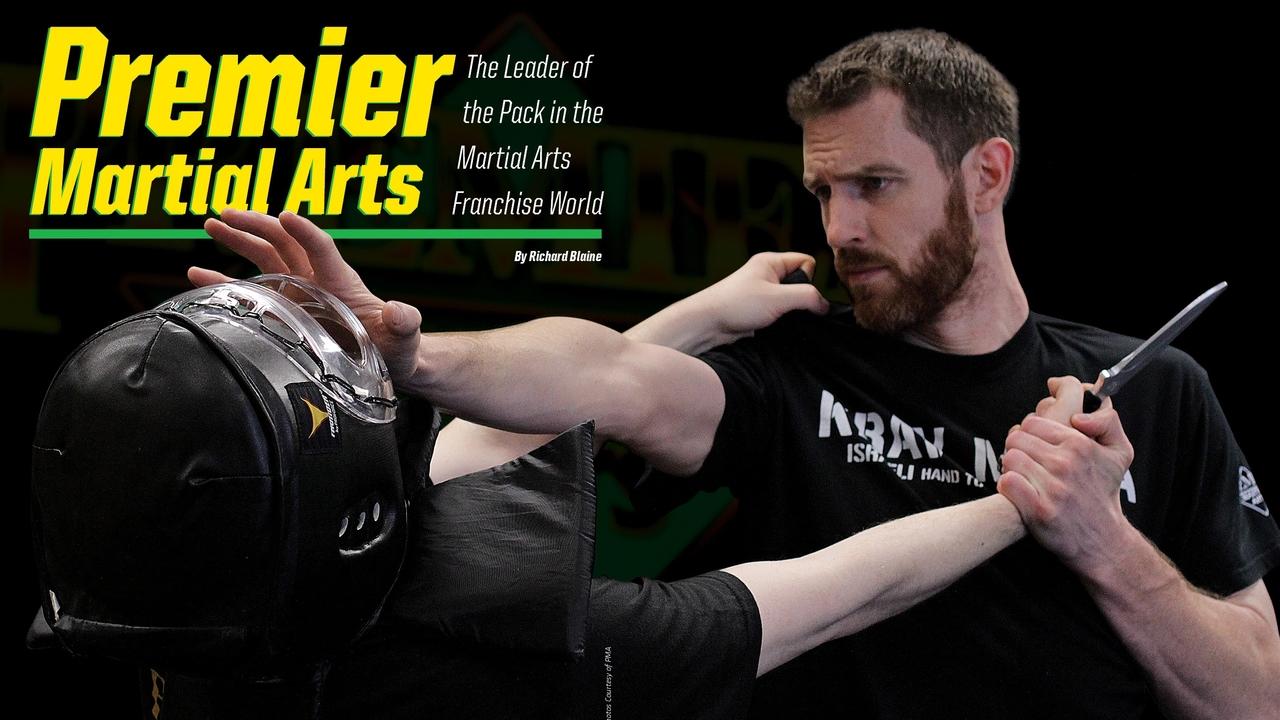
by Richard Blaine
Many martial artists dream of earning a living doing what they love. But when that dream meets the harsh reality of running a business, it can feel like being woken with a bucket of ice water to the face. Declining enrollments, departing students, the never-ending search for quality staff members, and turning just enough of a profit to pay bills and eat, then repeating this process month after grueling month — these things can turn that dream into a nightmare.
Yet a few school owners are running businesses that not only survive but also succeed beyond all expectations. At the top of that list of success stories is Premier Martial Arts.
With more than 100 schools in the United States, as well as branches in Canada and Great Britain, PMA stands as one of the world’s largest and most successful chains of franchised martial arts schools. And in a market saturated with everything from cardio-kickboxing gyms to Brazilian jiu-jitsu academies, every PMA school — with th...
5 Insights Into the Human-Relations Side of Retention

By Christopher Rappold
Finding out that a student is going to be leaving your school is never fun. If you care about making an impact on someone’s life and sincerely enjoy teaching, news of a departure can create some sleepless nights. While there is no magic answer to ensure this never happens, your time will always be well-spent ensuring that the highest percentage of your students remain dedicated to their training at your facility.
As I look back over 25 years of teaching, I do so with pride in what our team has produced. But, like you, I’ve been stung with the unexpected news of a student discontinuing his or her training more than once. Since we preach, “You can either get bitter or get better,” I offer the following preventative measures designed to keep such surprises to a minimum.
1. Know Your Students Beyond the Mat
It’s easy to forget that our students have lives outside the few hours they spend training with us each week. They have school classes, careers, familie...
5 Reasons to Focus on Superior Service Versus Sales

By Elite Consultant Jason Flame
Making a sale and providing excellent service go hand-in-hand. This has been on my mind a lot lately, and I’ve had many staff meetings focused around building this mindset. If we place just a little more focus on providing first-class service, we will not only generate sales now but also promote future sales through repeat business and referrals.
This is a challenge in any business. It’s easy to get caught up in the sales numbers alone. But if you take good care of your students, they will take care of you.
Here are five simple reasons this mindset is essential:
1. You’ll Attract New Students
This one is obvious! If you teach awesome classes, recognize and treat every student as an individual, pay attention to small details and genuinely take interest in your students, they will be happy to refer new business to you. When your students experience results, they will tell people. When they learn something of value, they will show people. When th...
7 Things Kids Learn From Martial Arts

Children’s martial arts classes not only tend to be profitable for schools but also are an amazing way to improve the lives of the kids, their families and the communities. This is because of the values the martial arts impart to children. Those values include the following:
Courage
The kind of courage that young people learn in martial arts is one that encompasses a certain spirit of bravery. It is not simply acting without fear; it is channeling an internal energy to act in spite of fear. Courage is a transferrable skill that allows students to set goals, overcome challenges and attain success both in the dojo and in life.
Respect
One tenet of martial arts is respect. Children are taught to respect the masters who came before them, as well as their instructors, their peers and themselves. Quality martial arts instructors focus on this value consistently, encouraging students to carry it with them beyond the studio. Self-respect and respect those who are above and below them...
The Difference Between Force and Strength

By Nguyen “Tom” Griggs
Hello, friends! I want to thank everyone who provided valuable feedback regarding my B.L.A.C.K. B.E.L.T. series. I promise to continue delivering valuable insights and information.
During the next five articles, we’re going to discuss how the concepts from Japanese jujitsu can be applied to your teams. I know that all our arts share similar principles, so feel free to apply them accordingly.
My instructor Torey Overstreet constantly reminds us that if you must use force to make a technique work, then you are doing it incorrectly. Now, some functional strength is necessary when applying a technique, but force implies a rough and harsh application of strength.
Effective leadership requires you to be strong all the time, but rarely forceful. I’ve known several leaders who firmly believed that if you had to raise your voice in anger or frustration, then you shouldn’t lead.
Here’s a story to illustrates the difference: My friend Ned is ...
Where Are My New Members?

By Kathy Olevsky
I believe most martial arts school owners and managers spend a great deal of time wondering what they should do to bring in new members. This is a dilemma I am well acquainted with.
One of the most important lessons I learned in this business came at a time when our numbers were dwindling. I couldn’t figure out how to get more leads. I had already reviewed all my notes from previous martial arts events and tried to double down on referrals — but to no avail.
Then a thought occurred to me: “I can’t be the only one dealing with this!” So, I went through the phone book and gathered the numbers of 10 other school owners. I called them one by one and asked each of them to give me three tips about things they did that garnered new leads. That was a great lesson in networking, as well as an excellent source of inspiration. The other owners were all very forthcoming, and we had a nice exchange of ideas, including what tactics were working and how we could help each other...
RETENTION DONE RIGHT!
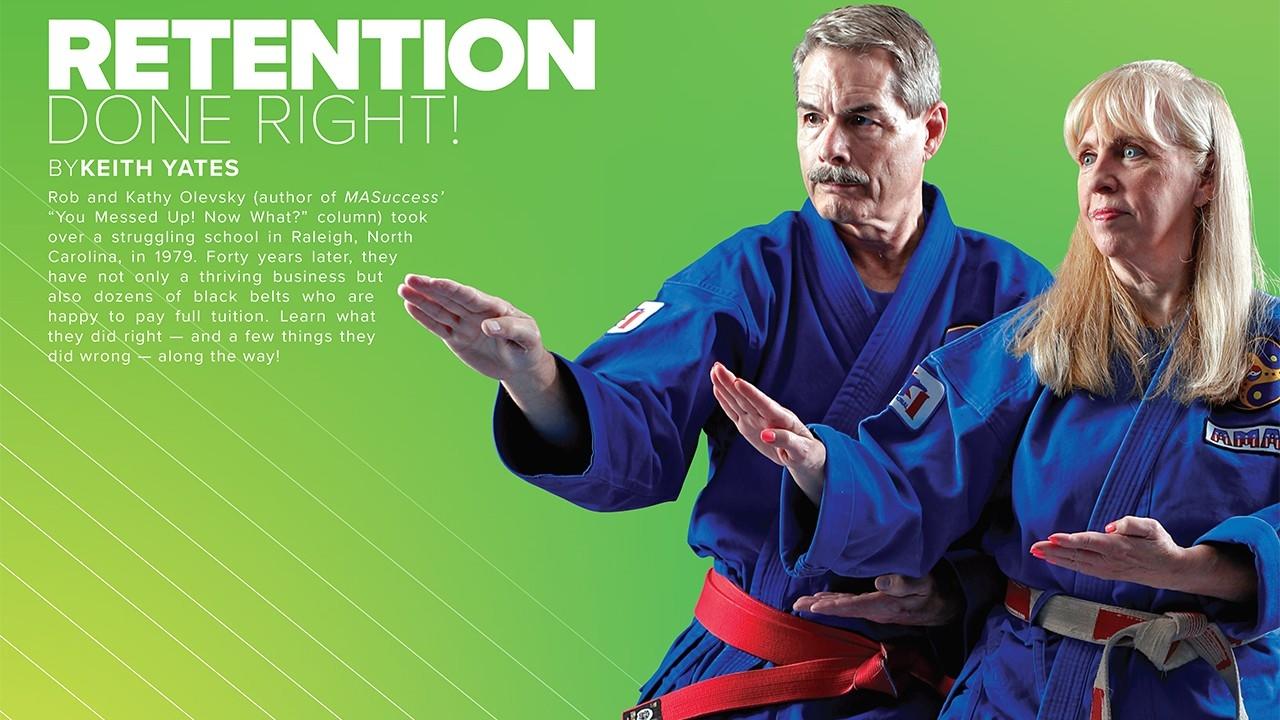
How Two Instructors Guide Their Students to Black Belt — and Then Retain Them as Contributing Members of the Dojo!
Rob and Kathy Olevsky (author of MASuccess’ “You Messed Up! Now What?” column) took over a struggling school in Raleigh, North Carolina, in 1979. Forty years later, they not only have a thriving business but dozens of black belts who are happy to pay full tuition. Learn what they did right — and a few things they did wrong — along the way!
By Keith Yates
It was the late 1970s, and Kathy Kilmartin was a 21-year-old taking karate lessons at the only martial arts school in Raleigh, North Carolina. She caught the eye of one of the instructors, a man named Rob Olevsky, but the dojo had a strict policy against teachers dating students. However, after repeated requests, the school’s owner says Rob could ask her out on a date — but only if Rob bought out Kathy’s contract in case she quit.
Rob agreed immediately, but Kathy wasn’t as eager when it came to dating. Rob ha...
How to Solve the Two-Inch Problem

By Christopher Rappold
What is it that separates a good competitor from a great competitor? I have asked that question many times, and I have heard many answers. To be great, someone must be fast. Or must be strong. Or must have a long reach. Or must have superior strategy. The list of answers goes on.
While all these are valid, I believe that the biggest deciding factor between good and great is whether a person can control distance.
This answer is what I would call “the elusive obvious.” It is self-evident, but sometimes we are so close to it that we don’t appreciate its value. If distance is controlled, then offense, defense, blocks, punches and kicks all work. If distance is off, they all are rendered useless.
If distance is such a critical element of success in martial arts, why is it that most schools place a premium on punching and kicking and only teach distance as a necessary evil? As I reflected on the answer and spoke with others, two answers emerged.
The first one i...
Motivate Your Masses: Part 2

Motivate Your Masses: Part 2
In my last column, Motivate Your Masses: Part 1, I went over some ways that you can inspire your “masses:” your students, their parents and your staff. However, much as you won’t have the energy to work out if you haven’t eaten, you won’t have the mental energy to motivate others if you’re not keeping up with your own welfare.
Part of being a great motivator is promoting a balanced lifestyle to those you care about. Home life, work commitments, online distractions and hobbies can pull you in a million directions. Internally, things can quickly become unbalanced, causing stress and unease.
Many will come to you for answers about how to create a successful, balanced life. Your words hold weight because of your position, so hand out wisdom with care. The answers you provide will be implemented, and those outcomes are a direct reflection of your ability to lead effectively. Realize that some will excel while others will falter within an...

Want Some Help with Your School?
Connect with us! Discover how MAIA can help you on your journey today.
Stay connected with news and updates!

Categories
All CategoriesRecent Posts