
MASuccess Magazine
The Martial Arts Industry Association's MASuccess Magazine exists to help grow martial arts participation by helping school owners succeed.
A New Start in the New Year

by Frank Silverman
As we prepare to enter 2021, we have an opportunity not only to look toward the future but also to reflect on the past. Nobody could have predicted how 2020 would turn out. It’s hard to believe that the pandemic has rolled over into the new year with us. In March, I had a conversation with my business partner Mike Metzger, and we agreed that COVID, although serious, would blow over soon. We figured it was a blip on the map of life with no real consequences. After a couple of weeks, life would be back to normal, we thought.
As we all know now, that prediction could not have been more wrong. We stopped in-person training and closed our schools in mid-March, then pivoted to virtual training. Not until June did we begin to allow students back into our schools. That’s when we quickly learned something that most other school owners likely discovered: Although we were ready to resume in-person training, our students were not so eager. They still wanted to learn, but th...
Relationships: Your School’s Most Important Asset

by Christopher Rappold
Think for a moment about your martial arts school and its current positioning. For better or worse, COVID-19 exposed a weakness in most martial arts programs across the country: We struggle to know what to do when we can’t teach lessons in person. I don’t pretend to have all the answers, but together, we need to learn as much as possible from this experience.
To spark the learning, I would pose a question: How do you compete against the thousands of free martial arts videos on YouTube? How do you take on the popular mainstream fitness videos and the free live training offered by their brands? How do you compete against Peloton Bike and dozens of other trendy home-workout items? Answer: You don’t!
Now, before anyone concludes that I’m saying you should just throw in the towel, I ask you to think a bit more strategically. Instead of, “How can I compete?” ask yourself, “What can I offer that others can’t?” The answer will be different for everyone.
I encourag...
Retention in the Age of COVID-19

by Christopher Rappold
If you had been told in January of this year that our world was about to shut down, would you have believed it? For most of us, the onset of COVID-19 was surreal, almost like watching a far-fetched movie plot unfolding in real time. And as with all unwelcome surprises, no one wants to go through it again. That said, I do want to make sure that our (literal) 20/20 hindsight results in the correct insights that will leave us better prepared for whatever else the future brings.
Because this column focuses on retention, my observations will target four key takeaways. The lessons to be learned — or relearned — from this pandemic are critical to sustained martial arts student retention and success.
1 Building strong relationships is a high-value activity.
To get through any kind of crisis requires more than just your efforts. It takes the collective support of friends, family, team members and the students in your school. Provided that these relation...
Our Industry Will Never Give Up!

by Kathy Olevsky
In the martial arts industry, we constantly have to reinvent ourselves to stay relevant. For example, many years ago, my husband and I ran a very traditional karate school. In the mid-1980s, the two of us moved into cross-training in other styles, but we kept it a secret from most students. We didn’t want to muddy our message, which was that we were a regular karate school.
What we learned is that offering multiple styles in one dojo can be a game-changer. That happened when we transitioned from teaching karate exclusively to offering instruction in karate, kendo, iaido, judo, jujitsu and a variety of weapons. Instead of it becoming confusing to the general public, it became enticing. Students liked the fact that we offered them more choices.
Similarly, we never could have predicted what happened to our world with the COVID-19 pandemic. All of a sudden, we had to transition from physical entities to online businesses. Not surprisingly, the martial arts industry a...
5 Experts Are Here to Help A Virtual Roundtable on Coping With COVID

MASuccess brainstormed with five prominent martial arts instructors to obtain their best advice for their peers during this global pandemic. Here is what they offered.
Immediately Start Teaching Your Art Online
Sometimes it’s best to begin with the end in mind. Do you want to help your students and families during the COVID-19 pandemic? Do you want to support your local schools, businesses and communities? Do you want to provide leadership during this a time of uncertainty? I’m guessing that you will answer yes to all these questions.
Now more than ever, people need to feel connected, and many of them need you to continue to serve as their instructor and their leader. Likewise, communities need leaders to provide certainty and security. Again, they need you to continue to be a martial arts leader to provide stability and structure. To do that, you’ll need to rely on technology, perhaps to a degree you never have. The good news is, it’s not that difficult.
First, however, we must...
Obstacles

by Beth A. Block
The next time you’re in your school, set aside five minutes for a tour of the space. Look at everything: the entryway, guest area, office, bathrooms and floor. Try to see it all through the eyes of someone who’s never been inside your building before. Take some notes on what you see. When you’re done, come back and pick this column up again.
OK, ready? Check your notes. Do they include the need to clean the entryway floors? Did you see a leaky faucet in the bathroom? A leak in a ceiling tile? An exposed sharp counter edge? Did you notice whether plug protectors are in the unused electrical outlets? Are there support pillars from the floor to ceiling? Where are they located, and are they padded?
During my years in martial arts studios, I’ve seen students and guests get hurt in many ways. One incident involved a studio that had a 15-year-old fall into a steel support pole. This student was participating in the adult class. On this particular evening, they were work...
How to Use Your Speed Bag for Kids' Classes
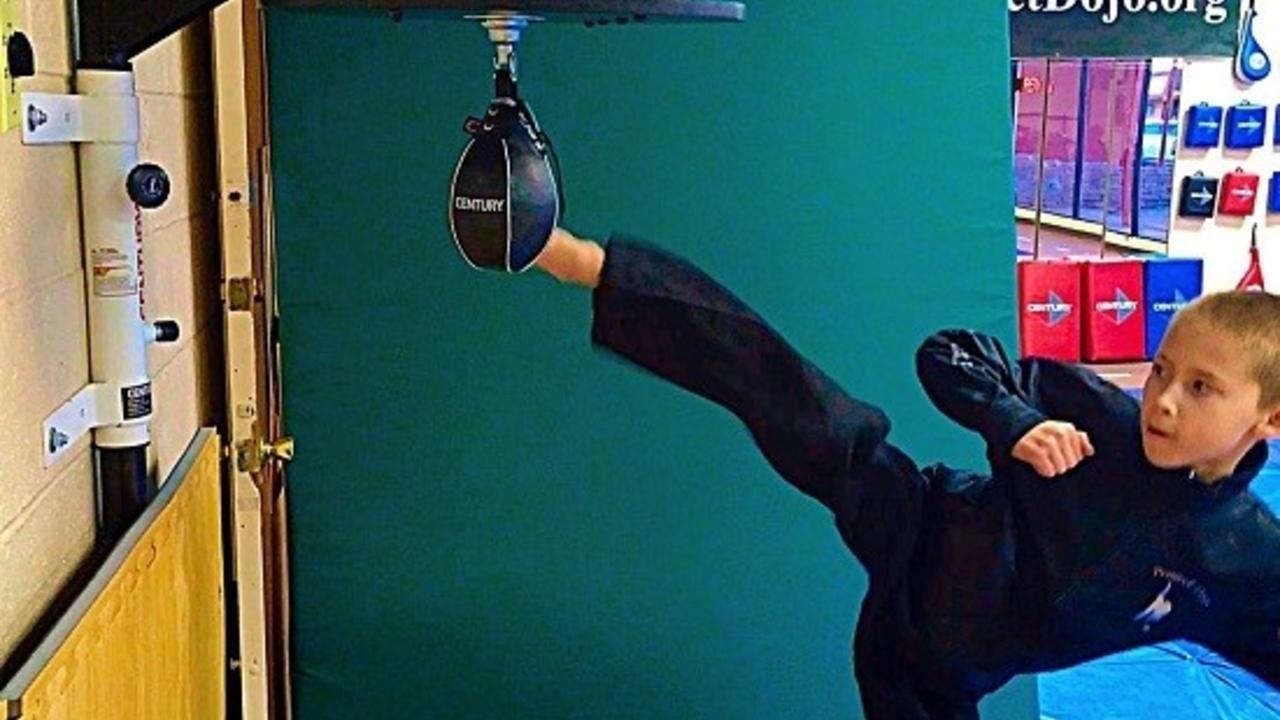
By Michelle Hodnett
Project Dojo is a nonprofit community outreach program in Pueblo, Colorado, that works with at-risk children. Through the power of martial arts, Project Dojo seeks to inspire and motivate kids within a safe environment, while continuing to teach the traditions of martial arts. This is the story of Project Dojo co-founder Michelle Hodnett’s experiences in her martial arts journey.

The Century Foldaway Speed Bag Platform & Leather Speed Bag is an excellent tool to build hand-eye coordination as well as speed and endurance. Speed bag training beneficial to all ages and all levels of martial artists, for several reasons:
- It increases hand speed, which helps eliminate wasted motion
- The repetitive striking action trains the user to keep their hands up – a habit that is essential if you’re even going to think about sparring
- It builds the trapezius muscle, which improves the overall snap of your punch
All of these things will benefit your students of ANY ages!...
Affordable Ways to Grow Your Martial Arts School

by Kurt Klingenmeyer, MAIA Consultant
Over the past year, I’ve had the incredible experience of working with many growing martial arts schools via MAIA’s Small School Forum. It’s a dedicated Facebook group for school owners with 80 or fewer students. The forum provides tools and advice to help them develop their schools.
One of the most frequently asked questions is, “How do I grow my martial arts school with only a small budget?” The following are five proven ways to do that.
Lead Boxes
This is an old-school form of marketing, but it always delivers results. Visit 10 local businesses that are community owned and tell the owners that you have students and families who may be interested in them. Ask if they have any business materials you could place at the front desk in your dojo.
If they have materials to share, ask if they can reciprocate by allowing you to leave a lead box on their counter. On the outside of the box, feature an enticing special like “one month of free les...
To Retain the Best, You Have to Give Your Best!

by Chris Rappold
It is always exciting to enroll new students. In most cases, it’s a fresh start with no history, only the promise of a bright martial arts future. The students enter your school and take their first class, receive their first promotions and win their first trophies. Everything is new and exciting.
Through continued hard work — both yours and the students’ — they continue to advance. At first, you may have just one advanced student, but in what seems like no time, you have a class full of brown and black belts. It’s a dream come true.
Then, without warning, one of those advanced students, perhaps even one you had mentally tagged as an assistant instructor, discontinues training. You feel like you got punched in the stomach. Why would the person suddenly stop training? Isn’t this what he or she always wanted? Why would the student come so far, only to quit? These questions and others race through your mind.
While you’ll never be able to prevent everyone from leavi...
The Beginner’s Mind: How Black-Belt Teachers Can Benefit From Adopting a White-Belt Mentality

by Justin Lee Ford
Shoshin is a word one encounters in the traditional Japanese martial arts, as well as in Buddhism. It doesn’t refer to a technique or form; rather, it’s a general concept. Translated, it means “beginner’s mind.” The term is used to remind practitioners to keep an open mind akin to that of a beginner in any endeavor.
In the martial arts, having a beginner’s mind can foster humility and make you receptive to new ideas. In the business of martial arts, having a beginner’s mind can help you connect with new students and retain current students.
How so? When you, as a martial arts instructor, remind yourself of what it’s like to start learning a new physical pursuit, you better connect with white belts. This is because there are many things newcomers don’t know but you take for granted. Adopting a beginner’s mind reacquaints you with their stage of training, and it aids you when it’s time to improve your advertising, remodel your dojo interior and fine-tune your com...

Want Some Help with Your School?
Connect with us! Discover how MAIA can help you on your journey today.
Stay connected with news and updates!

Categories
All CategoriesRecent Posts