
MASuccess Magazine
The Martial Arts Industry Association's MASuccess Magazine exists to help grow martial arts participation by helping school owners succeed.
Show Them Who You Are!

I‘ve been operating a martial arts school full time for 40 years. I think I may have made every mistake that can be made in this business. The reason I’m still in business, I believe, is because I asked for help. I learned quickly that others before me had already found solutions. In this reality-based column, I’ll point out key mistakes I made in my business career, which are common errors among school owners, both large and small, throughout our industry. Then I’ll share the solutions I applied to overcome them.
When I first started in the martial arts back in the late 1970's, it was common to hear an instructor say to a student, “Only one in 1,000 will make it to black belt.” That statement was a source of pride. It meant that a black belt was to be truly honored. It meant that a black belt wasn’t a common man (or woman); they were elite.
The statement was made with good intentions, but it did irreparable harm!
Anyone who is going to become a success in life needs to bel...
Family-Based Business Builds a Karate Empire!
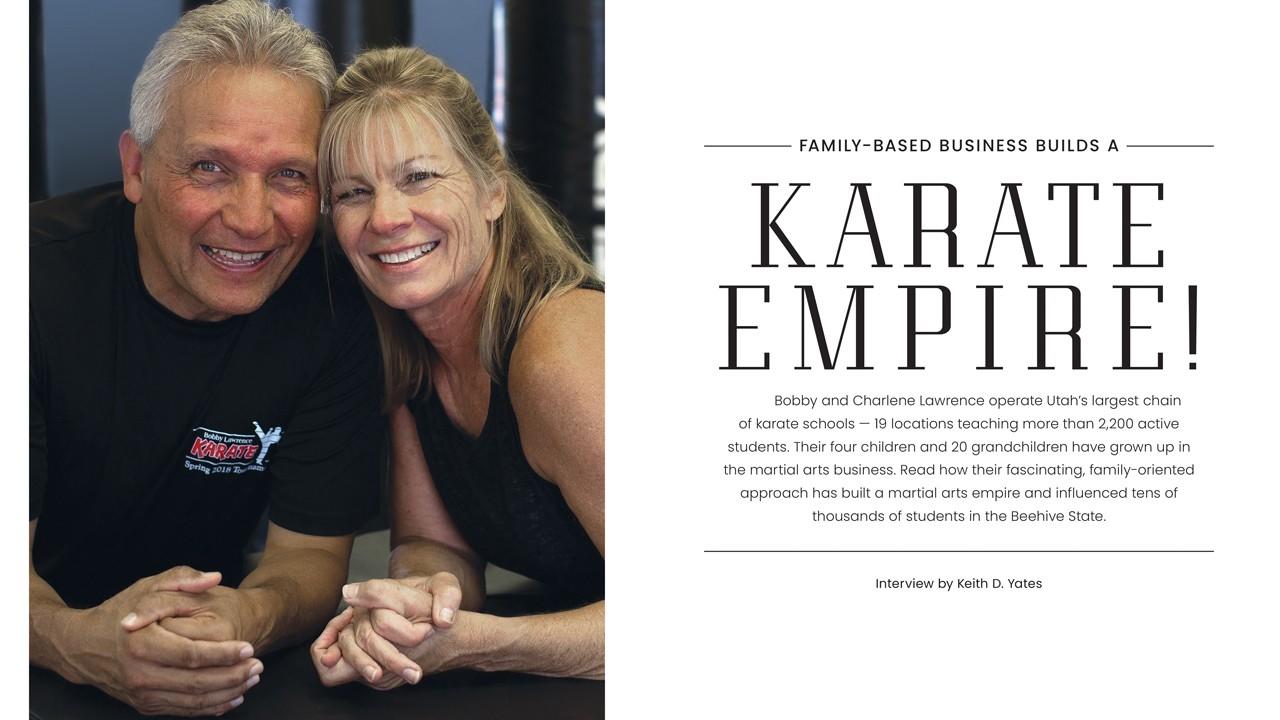
Bobby and Charlene Lawrence operate Utah's largest chain of karate schools — 19 locations teaching more than 2,200 active students. Their four children and 20 grandchildren have grown up in the martial arts business. Read how their fascinating, family-oriented approach has built a martial arts empire and influenced tens of thousands of students in the Beehive State.
By: Keith D. Yates
Once, Bobby Lawrence was a public school teacher, athletic coach and attorney. While he was busy working in the corporate world, his wife, Charlene, turned their martial arts hobby into a one-school business. Today, they run the largest chain of karate schools in the entire state of Utah, encompassing 19 different locations. They are all Bobby Lawrence Karate Schools, some of them licensed. But the husband-and-wife team, who’ve been in the martial arts business since the 1980s, oversee the chain’s operations.
And it isn’t just the two of them. Their sons and even grandkids (they have 20!) are school...
The Fine Art of Teaching Students With Down Syndrome

Dwight Trower has dedicated his time and skill to teaching kids and adults with Down Syndrome at his Family Martial Art Academy in St. Louis, MO. These special-needs martial artists never pay for a lesson. It's a labor of love for Trower that comes back tenfold with every kick and punch thrown by his students in this unique class.
By: Terry Wilson
Dwight Trower was in a trade school learning how to be an auto mechanic and, at the time, saw it as his clear-cut future. That is, until he took his first karate class. From that moment forward, he was propelled on a path that would eventually forever change his life and the lives of untold numbers of special-needs students.
“Even as a blue belt, I was an assistant teacher,” Trower says today. “My instructor told me that I had a gift for teaching, especially working with kids.
“With a class full of students, there were usually one or two of them that were on the autism spectrum or had Down syndrome. So, we’ve always had special-needs s...
Franchising the Martial Arts the Wave of the Future?

Knoxville, Tennessee’s Barry Van Over went from the hills of Appalachia to the forefront of the 21st-century martial arts revolution. Franchising is his dynamic vision for the future of martial arts businesses.
By Keith D. Yates
While people have been practicing martial arts for thousands of years, the ancient disciplines have never been more popular than they are today. Statista is an online statistics, market research and business-intelligence portal that provides access to data from market and opinion research institutions. The last time the company conducted a survey, in 2016, into how many people practiced martial arts, it discovered that almost four million people, ages six and older, were practicing martial arts.
With more than 20,000 martial arts studios operating across the nation and the rise of martial arts in the mainstream, there is reason to believe that those numbers would be even higher today.
One of the reasons why martial arts is so popular is because its pr...
Elementary School Program Produces Mass Enrollments

James Lee of Eagle, Colorado, has developed a unique way to funnel 30-40 public elementary-school kids right into his commercial school. So effective is his program that public-schools come to him year after year to do it again! Check out what he does differently and why it works.
Even though James Lee took his first karate lesson at the age of seven, he didn’t get past yellow belt until he was 13. No, it wasn’t because he was a slow learner. It was because he was moved from city to city as a child due to his parents’ work schedule. In spite of the moving around, he begged his parents to find a new martial arts school in each new city. According to him, he was so enthusiastic that he’d start his new classes before they even unpacked their boxed possessions!
At the age of 19, Lee was a brown belt and, in between enjoying the ski slopes, he continued to practice with the goal of going back to Louisiana to earn his black belt. Then, his plan was to return to the renowned ski resort town...
Billy Blanks’ Boom Boxing! Is it The Next Big Martial Arts Trend?

Tae Bo creator Billy Blanks has launched a new fitness program that can boost revenues for martial arts schools during off-peak hours. “Billy’s Boom Boxing” fuses aerobics with many martial arts customs, including katas, self-defense applications, bagwork, and even a rank system using colored hand wraps and gloves. School owners in the program could draw a new wave of fitness clients from the general public that normally won’t take martial arts lessons.
From 1998 to 2001, the first martial arts-oriented fitness program ever to capture the mass-market participation of the general public took hold. In fact, it became a worldwide fitness phenomenon. Called Tae Bo, a name based on the “tae” in taekwondo and the “bo” in boxing, it was created by retired semi-contact karate world champion and master-level black belt Billy Blanks.
Blanks launched the program at his karate school in Sherman Oaks, CA. It was a high-intensity aerobic fitness routine that fused martial arts and boxing techni...
Turning Point - July 2018

by Herb Borkland
As a 16-year-old Kansas City Golden Gloves fighter, Bob Thurman ran up an 86–3 record. In 1977, Thurman joined legendary karate pioneer Jim Harrison’s bushidokan style. Thurman entered pro kickboxing in 1979, posting a 19-1 record before his stunning 1982 defeat of world Middleweight Champion Alvin Prouder.
Thurman defended his World title 10 times. But, in 1989, after a mugger’s murderous assault on his wife, Betsy, he retired from the ring to create and teach worldwide his “CounterAttactics” system. It’s designed to stress mental awareness, psychological strategies, and tactics and techniques for surviving and escaping from street violence.
Bob Thurman: I grew up in Kansas City. My step-father ran a hotel-management company.
My real father was a Marine Corps colonel — a Marine’s Marine. I get my ass-kicking from him,
but my step-dad was an amazing human being.
Herb Borkland: How did you first hear about martial arts?
BT: I had a friend who was a brown belt in kara...
Inspiration Ovation - July 2018

by Karen Eden
Years ago, while working as a TV reporter in Pittsburgh, PA, I was sent out to cover a story about a wildlife refuge not too far off from the city.
The former wildlife specialist I interviewed seemed to have a heart for the unruly animals who wouldn’t conform to zoo and circus life. He also adopted the animals that people from around the country had mistakenly taken in as pets at one time or another.
I’ll never forget his words to me.
“I don’t care how tamed you think an animal from the wild may now be. They are always going to be wired to be wild and you must always keep that in mind,” he told me.
With that, he brought out one of his latest orphaned, unwanted animals. It was a bobcat … with a sinus issue. I honestly didn’t know whether to laugh or cry. This poor bobcat was consistently blowing his nose. Yet, he of course didn’t have the ability to grab or ask for a tissue.
“What can you do about it?” I asked the wildlife specialist. “Nothing,” he replied. “He’ll le...
Black Belt Leadership - July 2018

by Dr. Nguyen "Tom" Griggs
When I was around 15 years old, my dad (a.k.a., “Pop”) and I were working on his old ‘79 Dodge Ram Charger. It was banged up, had no air conditioning and the radio could barely stay in place in its holding brackets. As we worked, my dad had a life talk with me. He shared five rules for living that he abided by and made him successful.
I was honored to retell these points during his eulogy in June 2016. Seeing friends and relatives laughing and nodding in agreement told me that these are true pearls of wisdom. Allow me to share these points with you. I’ll frame them in the context of being successful in the areas of teams, leadership and conflict management.
1. Work hard and work smart. My dad was a very hard-working person. He advocated common sense, but knew that determination could only take you so far. Armed with only a high-school diploma, he and my mom became successful, but also embraced technology and efficiency.
Working hard and working smart are ...
The MAIA Report - July 2018

by Melissa Torres
Get ready! Next month is the official time to pack your bags and make your way to Las Vegas for the 2018 Martial Arts Super Show! There are so many incredible speakers, instructors, trainers, martial artists and fellow school owners you are about to meet. And there’s so much to see and do during the Show and at the chic Bellagio Hotel venue.
If you’re already signed up for the Show, you are no doubt looking for advice for growing your school. Or increasing retention. Or learning new ways of instructing. Or, you’rechecking out the latest products and services.
In this column, I wanted to point out a few highlights of in the Martial Arts Industry Association’s (MAIA) booth.
First of all, you must stop by to meet our incredible MAIA coaches. The entire team will be there, and will be excited to talk to you and answer any and all of your questions. Our goal is to help you succeed. So, don’t miss the opportunity to get your questions answered.
Most of our coaches will...

Want Some Help with Your School?
Connect with us! Discover how MAIA can help you on your journey today.
Stay connected with news and updates!

Categories
All CategoriesRecent Posts